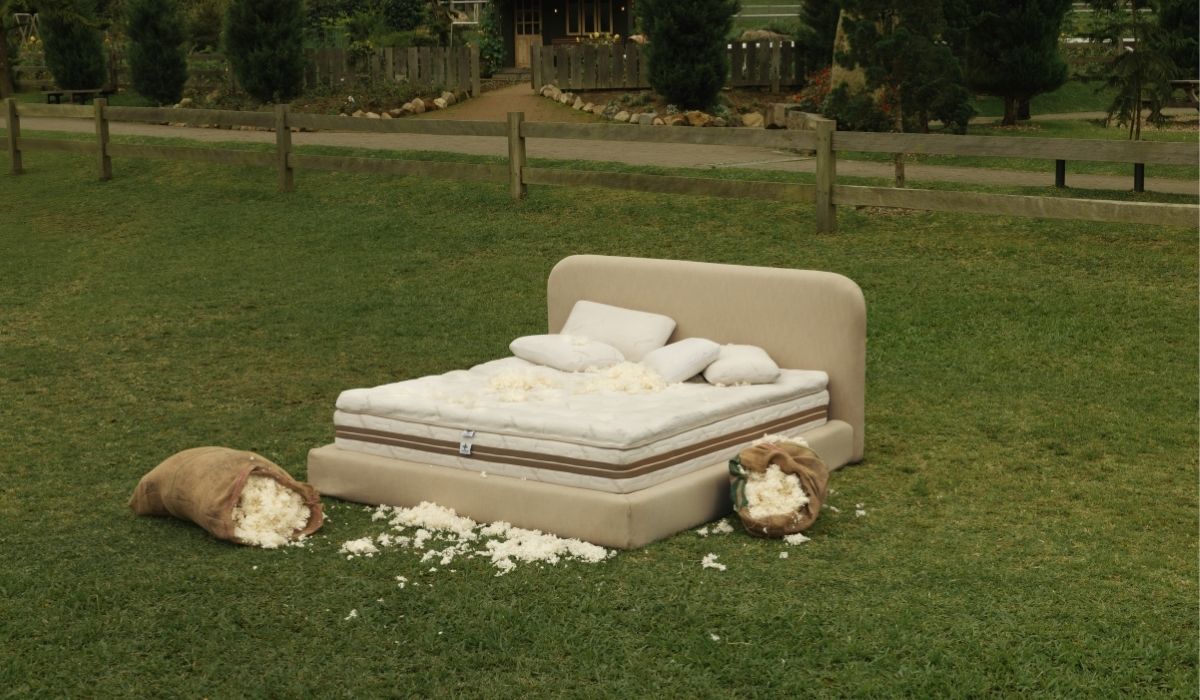
“We don’t sell warmth. Every filling on earth can be made warm. We sell a fibre that changes what it does depending on what you do.”
For generations, wool has been valued for its warmth. But its story goes far beyond that. A naturally responsive fibre, wool can manage moisture, regulate temperature and adapt throughout the night, qualities that make it as relevant to modern sleep as they were to the generations who first worked with it.

Harry Urquhart-Hay, Co-Founder of Wisewool, a New Zealand wool brand built around natural performance and farm-to-fibre traceability. As part of a fifth-generation wool family, Harry brings a deeply personal connection to the material and a fresh perspective on where it belongs today.
Through our partnership, Wisewool’s New Zealand strong wool comes together with Heveya’s natural latex, combining two materials that each bring something different to the sleep experience. We spoke with Harry about the story behind Wisewool, the natural intelligence of wool, and why warmth was never really the job.
A Fifth-Generation Wool Story

Harry’s relationship with wool is not something that began with Wisewool. It goes back more than a century. His great-great-grandfather, William Henry Smith, built the first wool scour in Gisborne in 1894. More than 130 years later, Harry and his family remain connected to the same region and the same industry.
Yet his path into Wisewool was far from direct. After beginning his career in advertising, Harry went on to help establish distribution for spatial audio company Orbitsound before returning to his family’s roots.
In 2021, Harry joined his auntie and uncle, Henry and Nicky, and his cousin Angus to launch Wisewool. The idea was simple but ambitious: take the wool their family had handled for generations and give it something it had never really had before: a brand, a story and a reason for people to ask for it by name.
New Zealand produces some of the world’s finest strong wool, yet much of it disappears into anonymous commodity markets. The farmer often remains invisible, and the consumer rarely knows where the material in their product came from.
Wisewool was created to change that.
“We built Wisewool as an ingredient brand, the way Gore-Tex is for jackets,” Harry explains. “When you see Wisewool in a product, you know exactly what’s inside, which farms grew it, and that it’s been made to do a job.”
Why Wool Belongs in the Bedroom
For Harry, the value of wool goes far beyond simply keeping you warm. Most synthetic fillings are passive. They trap heat, but they do little to respond to what the body is doing throughout the night.
Wool is different. It continuously manages moisture and temperature, while remaining resilient and naturally flame-resistant. And unlike synthetic fibres, wool is renewable, growing back on the sheep every year.
Its sustainability story continues beyond the farm. Synthetic fillings are derived from fossil fuels and can remain in landfill for centuries. Wool, by contrast, is made from keratin, a natural protein, and can eventually break down and return nutrients to the soil.
“One material comes from the land and goes back to it,” says Harry. “The other was never part of it.”
The Science Behind Temperature Regulation
One of wool’s most important qualities is also one of the least understood. We release moisture into our beds every night through sweat, breath and skin, around half a litre, regardless of whether the room is hot or cold.
Wool is naturally hygroscopic, meaning it can absorb water vapour from the surrounding environment. The fibre can hold up to a third of its own weight in moisture while still feeling dry against the body. As the night progresses, it gradually releases that moisture, allowing the fibre to reset.
Synthetic fibres behave very differently. Polyester absorbs less than half a percent of its weight in moisture, meaning much of that moisture can remain closer to the body, contributing to the sensation of heat and clamminess. This is what allows wool to work across different climates, from a cold house in Otago to a warm bedroom in Jakarta.
From Farm to Fibre

Wisewool’s story begins across more than 250 farms on New Zealand’s East Coast, the same region where Harry’s family has been working with wool since 1894.
Here, sheep live outdoors on pasture year-round, producing strong wool: a naturally resilient fibre with the crimp and spring to hold its loft and recover under weight.
Unlike the fine merino wool associated with clothing, strong wool is particularly well suited to filling applications such as mattress toppers. But for Wisewool, knowing the fibre is only part of the story. Knowing where it comes from matters just as much.
Every batch is assigned a WiseBatch number, connecting the finished wool back to the farms and families who produced it. It is part of Wisewool’s commitment to making the journey from farm to fibre visible and giving wool an identity beyond a material label.
Why Wool and Latex Work Together
The partnership between Wisewool and Heveya began with a shared belief: natural materials can perform exceptionally well when they are allowed to do what they naturally do best.
Heveya’s organic latex provides support and buoyancy. Wool brings something different, moisture management, temperature regulation and a soft, resilient layer between the sleeper and the latex.
The two materials therefore complement rather than compete with each other. Wool manages the sleeping microclimate while latex provides the underlying support. Wool is also naturally flame-resistant, making it a natural choice as a protective layer around latex.
For Wisewool, the partnership with Heveya was a natural fit because both brands share a commitment to materials, transparency and thoughtful craftsmanship.
“Heveya builds products the way we think they should be built: natural materials, no shortcuts, and a real point of view on sleep.”
Importantly, Heveya was also willing to put the Wisewool name on the finished product and tell the traceability story properly. Rather than simply saying that a product “contains wool”, the partnership allows the material to retain its identity.
A Different Way to Think About Warmth

Perhaps the most important lesson from wool is that warmth itself is not the goal. The body already produces heat.
What it needs is a material capable of responding to that heat, managing moisture and adapting throughout the night.
“Your body already makes the heat,” Harry says. “What it needs is something that responds.”
Before choosing your next duvet, topper or mattress, his advice is simple: look beyond the label.
Ask what is inside.
Ask where it came from.
And ask whether anyone can actually tell you.
If nobody can answer, that tells you something.
Frequently Asked Questions
1. Is wool good for bedding?
Yes. Wool bedding is made from a natural fibre that manages moisture and temperature throughout the night, while staying resilient and naturally flame-resistant. Unlike most synthetic fillings, which simply trap heat, wool responds to what your body is doing. It is also renewable, growing back on the sheep every year.
2. How does wool regulate body temperature?
Wool is hygroscopic, which means it absorbs water vapour from the air around you. The fibre can hold up to a third of its own weight in moisture and still feel dry against your skin. As the night goes on, it releases that moisture gradually and resets, so your sleeping environment stays balanced.
3. Does wool keep you warm or cool at night?
Both. Your body already produces the heat it needs, so wool bedding does not add warmth for the sake of it. Instead, it draws moisture away from you and adapts as conditions change. That is why it works as well in a cold house in Otago as it does in a warm bedroom in Jakarta.
4. Is wool better than polyester for sleeping?
For comfort and moisture control, yes. Polyester absorbs less than half a percent of its weight in moisture, so dampness stays close to the body and can leave you feeling hot and clammy. Wool absorbs far more and releases it again, which keeps you drier. Wool is also made from natural keratin and can break down and return to the soil, while polyester comes from fossil fuels.


