You spend roughly a third of your life in bed eight hours a night pressed against your bedding close enough that what your mattress protector is made of genuinely matters. Most people choose a protector as an afterthought, grabbing whatever is cheapest or most convenient.
But conventional protectors often use synthetic coatings and plastic-derived waterproofing that sit directly against your skin night after night. An organic mattress protector takes a fundamentally different approach: natural materials, certified chemical-free production, and breathability that doesn't compromise your sleep. Here's what that actually means in practice and how to decide if it's right for you.
Quick Overview
- Most conventional protectors are coated in polyurethane or vinyl petroleum-derived materials that trap heat and can off-gas chemicals over time.
- An organic mattress protector uses certified natural materials like organic cotton and bamboo lyocell to shield your mattress from sweat, allergens, and dust mites without synthetic chemicals or a compromise on breathability.
- Certifications such as GOTS and OEKO-TEX Standard 100 are the most reliable way to verify a product's chemical safety claims.
- Using a mattress protector is often a condition of preserving your mattress warranty.
What Makes a Mattress Protector "Organic"?
The word "organic" in bedding refers to how raw materials were grown and processed. An organic mattress protector is typically made from cotton cultivated without synthetic pesticides, herbicides, or GMOs. Many also incorporate bamboo lyocell a soft, moisture-wicking fibre produced in a closed-loop system that recycles up to 99% of the pulp solvent during manufacturing.

What sets an organic protector apart from a conventional one is that the entire production chain from farming through to finishing avoids synthetic chemicals. That applies to the fabric, the dyes, the stitching, and any finishing treatments.
Most conventional mattress protectors achieve waterproofing through a layer of polyurethane or vinyl bonded to the underside of the fabric. While effective at repelling liquid, these materials are petroleum-derived, non-breathable, and can release low-level chemical emissions over time a process known as off-gassing.
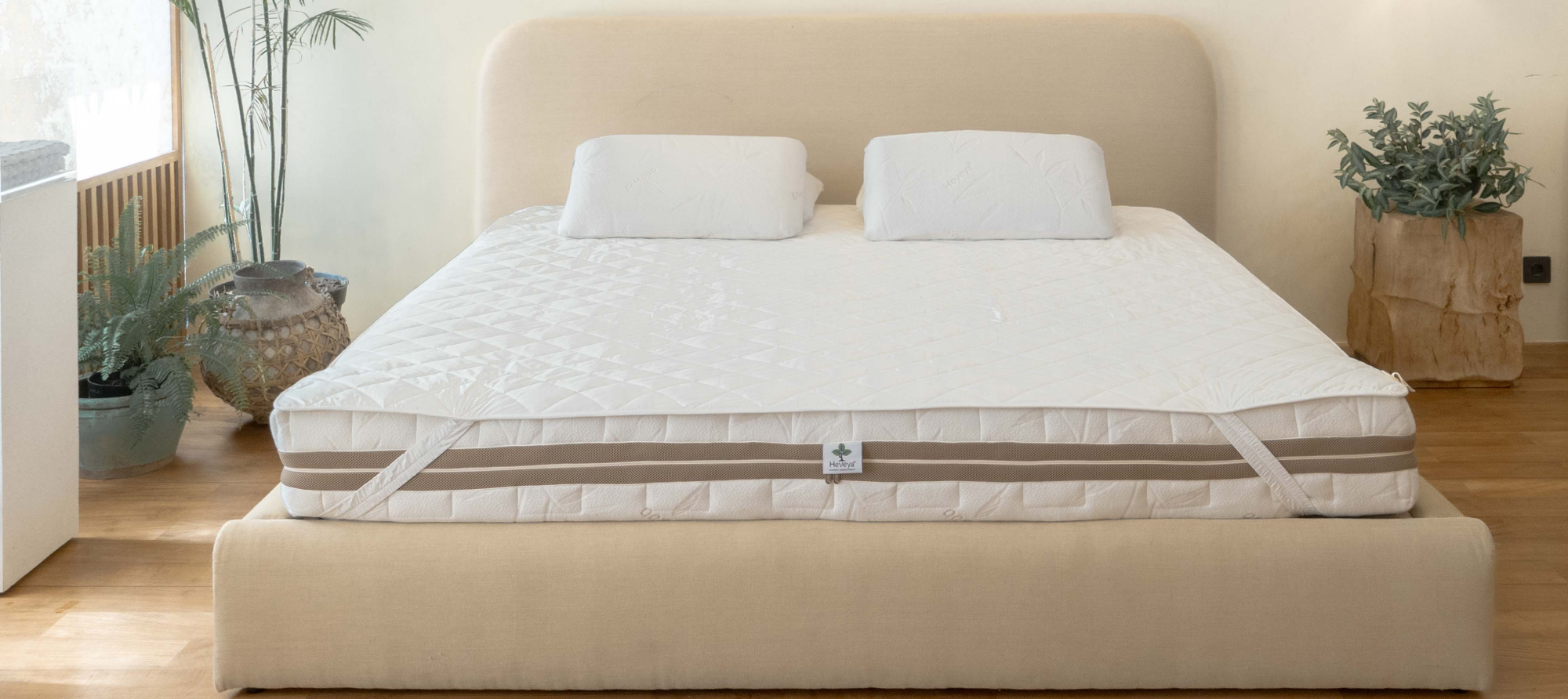
Heveya's Organic Mattress Protector takes a different approach: a tightly woven layer of GOTS-certified organic cotton backed with bamboo lyocell padding. This creates a naturally water-resistant barrier that absorbs moisture and protects against everyday spills without any synthetic membrane, without off-gassing, and without the heat retention that makes conventional protectors uncomfortable in Dubai's climate.
What Does a Mattress Protector Actually Do?

Protects Against Spills and Sweat
The most fundamental function of a mattress protector is physical protection. Mattresses are difficult to clean and impossible to fully sanitise once liquid has penetrated the core layers. A protector acts as a removable, washable barrier that keeps moisture from reaching the mattress itself.
This matters more than most people realise in Dubai. The city's air conditioning runs almost year-round, but the intense desert heat and frequent transitions between scorching outdoor temperatures and cool indoor environments cause the body to regulate temperature intensively during sleep. The average person loses around 200ml of sweat per night and in Dubai's climate, that figure can climb considerably. Without a protector, that moisture is absorbed directly into the mattress over months and years, creating conditions for deterioration that no amount of airing out will fully reverse.
Guards Against Allergens and Dust Mites
Dust mites are microscopic organisms that feed on dead skin cells, and a mattress without a protector is an ideal environment for them. A tightly woven organic cotton protector creates a physical barrier that limits dust mite access to the mattress core while remaining breathable for the sleeper above.
The dense weave of high-quality organic cotton can be as effective as synthetic alternatives at blocking allergens, without the heat retention or chemical exposure that comes with synthetic materials. Dubai's indoor environments heavily air-conditioned and often sealed against outdoor dust and sand can concentrate allergens indoors, making this protection particularly relevant for allergy and asthma sufferers.
Extends Your Mattress's Life
A quality mattress is a significant investment. Natural organic latex mattresses, in particular, are engineered for long-term performance typically 15 to 20 years but that longevity depends on the conditions they're kept in.
A protector reduces the rate at which the mattress cover absorbs body oils, sweat, and staining, preserving both the hygiene and structural integrity of the mattress beneath. With regular use and care, an organic protector itself will typically last 5 to 7 years, compared to 2 to 3 years for most conventional synthetic protectors. Most mattress manufacturers also recommend using a protector as a condition of their warranty skipping this simple step can void coverage on a product you've spent thousands of dirhams on.
Do You Really Need One?

The short answer is yes and the case for an organic protector specifically becomes even stronger in Dubai's environment.
If you run warm at night, sweat during sleep, have allergies or sensitive skin, share your bed with a partner or children, or have invested in a high-quality mattress, the argument is straightforward. A breathable organic protector addresses all of these concerns without introducing the heat retention or chemical exposure that synthetic alternatives bring critical in a climate where anything that traps heat will directly impact sleep quality.
There's also a consistency argument worth making. If you've already invested in a natural or organic latex mattress, you've made a deliberate choice to reduce synthetic material exposure in your sleep environment. Sleeping on a protector coated in polyurethane sits in direct contradiction to that. An organic protector completes the environment your mattress is designed to provide.
What to Look for When Buying an Organic Mattress Protector
Not all products marketed as "organic" are equal. Here's what to check before buying:
- Certifications on the full product, not just the cover. GOTS or OEKO-TEX Standard 100 certification verifies that chemical safety claims extend across the entire product, not just the outer fabric.
- A fitted design with elastic corner straps that stays securely in place through movement.
- Honest washing guidance. Natural fibres are generally washed at 40°C to preserve their integrity. Check the manufacturer's instructions and follow them consistently.
- Breathability. In Dubai's AC-dependent environment, a protector that traps heat will noticeably disrupt sleep. A good organic protector shouldn't alter the feel or temperature of the mattress beneath it.
- Flat, unpadded construction. A protector sits beneath your sheet and adds protection, not comfort. If it's quilted or heavily padded, it's a topper, not a protector.
Common Mistakes When Choosing a Protector
- Choosing on price alone. Budget protectors are almost always synthetic-coated and will make the bed sleep significantly hotter a real problem in Dubai where comfortable sleep already depends on effective air conditioning.
- Confusing a topper with a protector. A quilted topper adds softness; a protector adds protection. They do different jobs.
- Buying "organic" without checking certifications. The word "organic" isn't regulated on its own in textiles certifications are.
- Skipping it on a new mattress. The first few months are when a mattress is most vulnerable to setting stains and absorbing body oils don't wait until something spills to add protection.
- Washing too infrequently. Even in an air-conditioned bedroom, Dubai's climate means the body works harder to stay cool during sleep. Washing your protector every two to four weeks keeps it hygienic and performing at its best.
Protect What You've Invested In
Your mattress is one of the most used items in your home and one of the most expensive to replace. In Dubai's climate, that investment needs protecting the combination of intense heat, frequent temperature shifts, and year-round air conditioning creates conditions that work against an unprotected mattress over time.
Heveya's Organic Mattress Protector is made from GOTS-certified organic cotton and bamboo lyocell, designed specifically to work alongside Heveya's natural latex mattresses. It protects against sweat, allergens, and daily wear without synthetic coatings, without off-gassing, and without compromising the breathability your sleep depends on.
If you've chosen a mattress worth protecting, this is how you protect it.