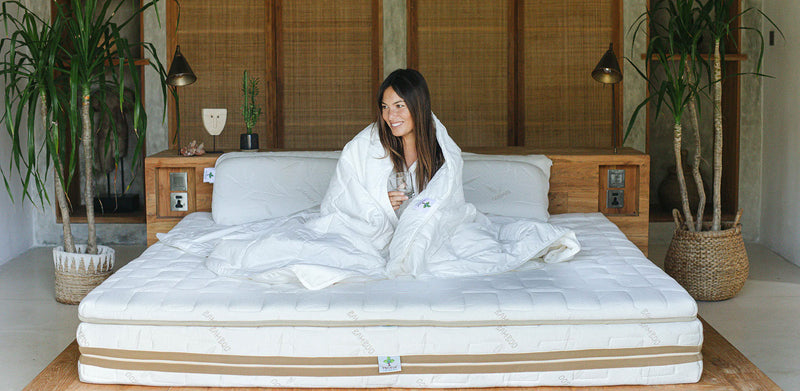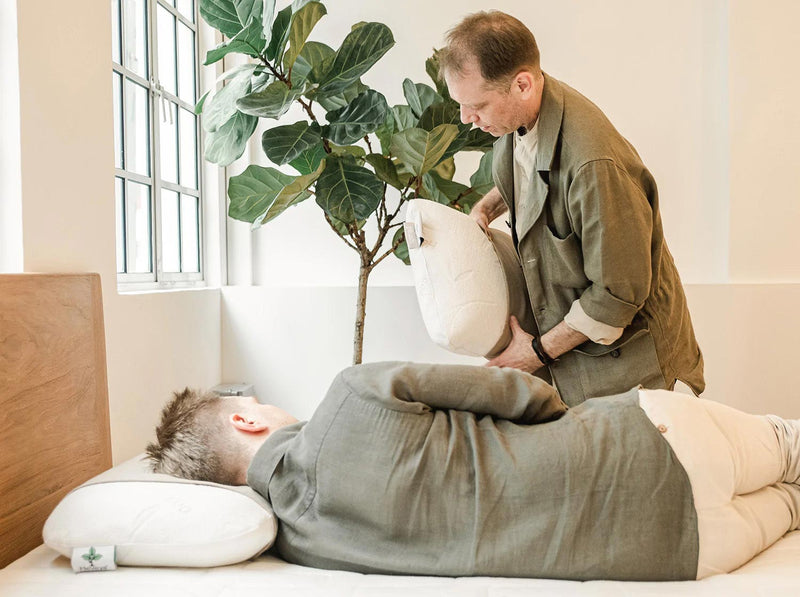
If you've ever woken up with a stiff lower back, a numb shoulder, or that flat feeling of having rested without actually recovering, your mattress probably doesn't know your body exists.
Most mattresses apply the same pressure response from head to toe. That's a problem, because your body isn't uniform. Your shoulders need room to sink. Your lumbar spine needs to be held up. Your calves need almost nothing at all. A single-firmness surface can't do all of that at once.
A latex mattress with 7 comfort zones is built differently. It divides the sleep surface into seven distinct support areas, each calibrated to respond to a specific part of the body. The result isn't just a more comfortable mattress it works with how you're built, rather than against it.
Quick Overview
- What comfort zones in a latex mattress actually are
- What each of the 7 zones does and why it's positioned where it is
- Why the 7-zone system produces better sleep
- How zoned natural latex compares to memory foam, pocket springs, and non-zoned latex
- What to look for and what to avoid when choosing a 7 zone latex mattress
What Are Comfort Zones in a Latex Mattress?
Comfort zones are areas of varying firmness built directly into the mattress core. A zoned latex mattress uses a structured pattern of perforations, density variations, or cuts to create regions that are softer in some areas and firmer in others.
In a 7-zone design, the mattress is divided into seven horizontal bands that correspond to the key weight-bearing and pressure-sensitive regions of the human body. Each band is tuned to give where the body needs to sink in, and resist where it needs to be held up.
Natural latex is especially well-suited to this construction. It responds with what sleep scientists call point elasticity it deflects precisely at the point of contact without creating a ripple of movement across the rest of the surface. That localised responsiveness is what makes zoning work in a way that memory foam or spring systems struggle to replicate.
The 7 Comfort Zones, Explained

Zone 1: Head and Neck (Medium-Soft)
The head is relatively light. The cervical spine needs gentle cradling, not resistance. This zone works in tandem with your pillow to hold the neck in neutral alignment reducing the tension that builds overnight in the upper trapezius when the head sits even slightly out of position.
Zone 2: Shoulders (Soft)
For side sleepers, this is the most important zone in the mattress. The shoulder is a wide, bony structure that concentrates significant pressure when you lie on your side. A softer shoulder zone lets it sink downward so the spine can stay level rather than bowing upward toward the ceiling. Without this give, side sleepers typically wake with numbness or aching in the upper arm and shoulder joint. This zone is why a well-designed 7-zone latex mattress performs so differently from a uniform one.
Zone 3: Upper Back (Medium)
The upper back is structurally stable on its own, but it plays a connective role between the shoulder zone above it and the lumbar zone below. When this section loses even contact with the mattress, load doesn't disappear it shifts. The shoulders and lower back absorb more than they should, compounding the tension those zones are already managing. This zone keeps that from happening, giving the thoracic muscles consistent support so the rest of the spine isn't overcompensating through the night.
Zone 4: Lumbar Region (Firm)
This is the firmest zone, and the most important one for anyone who wakes up with lower back pain.
When the lumbar region sags into a surface that's too soft, the natural inward curve of the lower back collapses. The intervertebral discs come under pressure. The muscles that support the spine are forced to work through the night rather than recover. A firmer lumbar zone counters this by lifting and supporting that curve keeping the spine in the alignment it was designed to hold. If you're shopping a natural latex mattress specifically for lumbar support, this is the zone to evaluate.
Zone 5: Hips and Pelvis (Medium-Firm)
The hips carry more body mass per surface area than anywhere else. This zone offers enough resistance to prevent excessive sinking while still allowing some contouring around the hip bones. For back sleepers, it keeps the pelvis level. For side sleepers, it works alongside the shoulder zone to keep the spine horizontally straight from top to bottom.
Zone 6: Thighs
The thighs exert less pressure than the hips and need a softer response one that lets the legs rest naturally without feeling pushed upward. This softer transition releases tension in the hip flexors that accumulates through the day and can persist into the night on a mattress without proper zoning.
Zone 7: Lower Legs and Feet
The calves and feet generate minimal pressure. This zone simply needs to make comfortable contact without restriction. A softer response here supports circulation and prevents the low-grade discomfort that harder surfaces can create against the Achilles tendon or heel the kind of irritation that doesn't wake you fully but still degrades sleep quality.
Why the 7-Zone System Produces Better Sleep
Your Spine Has Four Curves. Your Mattress Should Respect All of Them.
The spine isn't a straight line. It curves inward at the neck, outward at the upper back, inward again at the lower back, and outward at the sacrum. A single-firmness mattress treats it as though it were flat. A 7-zone mattress is calibrated to support each curve simultaneously firmer where the body is heaviest, softer where it needs to decompress.
Fewer Pressure Points Means Fewer Wake-Ups
Pressure points form when a mattress resists the body uniformly across bony prominences the shoulder, the hip, the knee. Over a full night, sustained pressure restricts blood flow and triggers micro-awakenings as the body shifts position to relieve the discomfort. Most people don't remember these disruptions, but they show up as fatigue the next day. Zoned support reduces both the number and intensity of these pressure points, allowing longer, deeper sleep cycles.
It Works Regardless of How You Sleep
Whether you sleep on your back, side, or switch between the two, the zones are positioned to match your body's geometry in each position. Side sleepers rely on the softened shoulder and hip zones. Back sleepers depend on the firmer lumbar zone. Combination sleepers benefit because the zones hold their correct positions relative to body length, no matter how you move.
Zoned Latex vs. Other Mattress Types
|
Feature |
Heveya Natural Latex Mattress |
Memory Foam Mattress |
Pocket Spring Mattress |
|
Targeted body support |
Yes - 7 distinct zones |
Limited zoning available |
Partial, via spring tension |
|
Spinal alignment |
Excellent across all positions |
Good for back sleepers |
Variable by spring quality |
|
Shoulder pressure relief |
High (softer shoulder zone) |
Moderate to high |
Moderate |
|
Lumbar support |
High (firmer lumbar zone) |
Moderate |
Variable |
|
Breathability |
Excellent (natural open-cell latex) |
Poor to moderate |
Good |
|
Durability |
20+ years typical lifespan |
7 - 12 years |
8 - 15 years |
|
Natural & organic options |
Yes |
Rarely |
Rarely |
How to Choose the Right 7 Zone Latex Mattress
Match the Zones to Your Sleep Position
If you primarily sleep on your side, the shoulder and hip zones should be meaningfully softer than the lumbar zone not just slightly different. If you sleep on your back, prioritise a model with a clearly firmer lumbar zone. Many mattresses claim zones but apply only marginal firmness variation across them; ask specifically how each zone is constructed.
Factor In Your Body Weight
Lighter sleepers need a softer overall tension so the softer zones can actually contour. Heavier sleepers need a firmer baseline so the zones can still differentiate without bottoming out. A mattress that's too firm for your weight won't let the shoulder and hip zones do their job regardless of how well-designed the zoning is.
Give Your Body Time to Adjust
Switching from a uniform mattress to a properly zoned one often involves a one-to-two-week adjustment period. Muscles and connective tissue that have adapted to compensate for poor support take time to release. A trial period of 30 nights or more is the minimum needed to accurately assess whether a mattress is working for your body.
Common Mistakes When Buying a Zoned Latex Mattress
Deciding in a Showroom
A five-minute lie-down doesn't tell you how a mattress will feel after eight hours, at your actual body temperature, in your actual sleep position. Always look for a home trial period. It's the only meaningful test.
Assuming More Zones = Better
A well-calibrated 7-zone mattress will outperform a poorly designed 9-zone one. What matters is whether the zone boundaries map accurately to human anatomy and whether the firmness differential between zones is significant enough to do real work. Ask to see the zone diagram before you buy.
Not Talking to Your Partner
If you share a bed, you're deciding for two different bodies potentially with different weights, sleep positions, and sensitivity levels. Natural latex's point elasticity means movement on one side rarely disturbs the other, but firmness preference can still differ. Discuss both sleep profiles before settling on a tension level.
Wake Up Feeling Like You Actually Slept
If you've been reading this because your back aches in the morning, your shoulder is sore by the time you get up, or you just never feel fully rested, the problem is probably structural, not circumstantial.
The right mattress doesn't just feel comfortable when you lie down. It works through the night so your spine stays aligned, your pressure points stay clear, and your muscles can actually recover.
Heveya's natural organic latex mattresses are built with 7-zone support at their core not as a marketing feature, but as the core of how they're engineered. If you want to understand what the right zone feels like under your body before you commit, visit our Sleep Studio and our advisors will walk you through it in person.